Monday, June 30, 2008

Red-Spotted Purple Butterfly


Red-Spotted Purple (Limenitis arthemis astyanax)

The Red-Spotted Purple (which is mostly blue and has orange spots) is common throughout eastern and central North America. Willow, popular and cottonwood are common larval hosts, but larvae have been found feeding on a wide variety of other plants including cherry, apple, pear, birch, oak, beech and basswood as well as currant and blueberry bushes. Adult Red-Spotted Purples visit flowers, but are most commonly found on sap, rotting fruit, carnivore scat and, especially, mud, which is where I found this butterfly.

The Red-Spotted purple is considered a mimic of the Pipevine Swallowtail, which is reputed to have a bad taste to butterfly predators . It is a subspecies of the White Admiral , a species found mostly in northern North America.


Share/Bookmark

Sunday, June 29, 2008

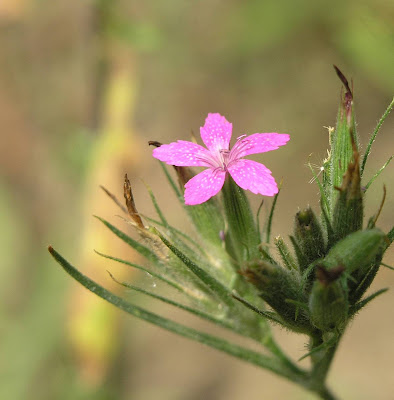
Deptford Pink (Dianthus armeria)


Deptford Pink (Dianthus armeria)

This pretty little pink flower was introduced from Europe as a nursery plant, but has long since escaped cultivation and grows wild throughout almost all of North America. It is now classified as an invasive weed by the Souther Weed Science Society. It's common name is taken from the Deptford district of South London where it once grew in abundance.

The Ozarks provide excellent growing conditions for Deptford Pink which prefers full sunlight in mesic to dry conditions and flourishes in a clay-loam or gravelly soil that is somewhat compacted and heavy. It is found in open woods, roadsides, railroads, waste ground, pastures and fields. This species declines in high quality habitats because it isn't competitive with many broad-leaved perennial forbs.

The plant is 1 - 2 1/2 feet tall and very slender and grass-like in appearance. It blooms from late spring into mid-fall. Flower clusters form atop the stems. Deptford Pink has a slender taproot and spreads by reseeding itself.


Share/Bookmark

Saturday, June 28, 2008

Leaf-Footed Bug Nymph


Leaf-Footed Bug Nymph

The nymph stages are often quite colorful and exotic-looking, but impossible (for me) to identify.
(Yet another sucker of plant juices.)

Share/Bookmark