Friday, August 29, 2008

Tiger Bee Fly (Xenox tigrinus)

.
Tiger Bee Fly (Xenox tigrinus)

.
These relatively large flies (12-19 mm -- 5/8" or so) don't start showing up around our place until mid-summer. Then, I most often notice Tiger Bee Flies among the rafters on our porch. They often hover near a rafter and then thump it with their heads. I don't quite have the sequence of events worked out yet, but what the flies are doing is hunting for a unprotected nest containing carpenter bee larvae. If successful, the female Tiger Bee Fly will lay her eggs in the nest and her larvae will feed on the carpenter bee larvae.

.

Share/Bookmark

Wednesday, August 20, 2008

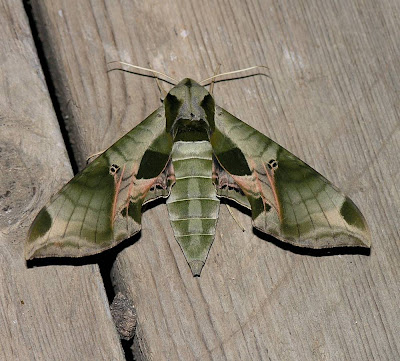
Pandorus Sphinx Moth (Eumorpha pandorus)

Photo taken 7/11/07

Pandorus Sphinx Moth (Eumorpha pandorus)

Range:  Eastern United States (Maine to Florida, west to Texas, north to Nebraska and Wisconsin) plus Ontario and Nova Scotia

Food:  Larvae feed on leaves of peppervine (Ampelopsis spp.), grape (Vitis spp.), and Virginia Creeper (Parthenocissus quinquefolia).  Adults nectar from flowers including petunia (Petunia hybrida), bouncing bet (Saponaria officinalis), and white campion (Lychnis alba).

Around our place we have enough grape vines and Virginia Creeper to feed an army of these moths.

Links:
 .

Share/Bookmark

Monday, August 18, 2008

Thick-headed Fly (Physoconops sp)


Thick-headed Fly (Physoconops sp)

Another one of the wasp-mimic flies, most thick-headed flies resemble thread-waisted wasps. Adults visit flowers and feed on nectar. Larvae are internal parasites of bumblebees and various wasps. The female Physoconops is said to lay her eggs on host species while in flight. The eggs hatch and bore into the host which they consume from the inside out.


(Photos from 7/04/07)


Share/Bookmark