Showing posts with label Manduca sexta. Show all posts

Wednesday, July 28, 2010

Tobacco Hornworm (Manduca sexta)


Stretching To Reach The Best Parts

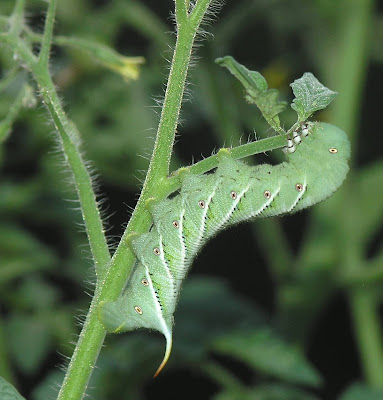
This is the critter most folks (including me) call a Tomato Hornworm, but according to BugGuide it is actually a Tobacco Hornworm.  The white literal stripes edged with black and the curved, reddish-colored terminal horn are distinctive.  Regardless, it is the larva of a Carolina Sphinx Moth and can often be found munching on members of the Nightshade family throughout most of North and South America.  (We've also found them eating pepper plants in our garden.)


(The University of Florida has an excellent page comparing Tobacco and Tomato Hornworms, including adult moth images.)

.
Share/Bookmark

Saturday, September 06, 2008

Tomato Hornworm Bearing Braconid Wasp Parasites

.
.
A Good Tobacco (Tomato) Hornworm
.
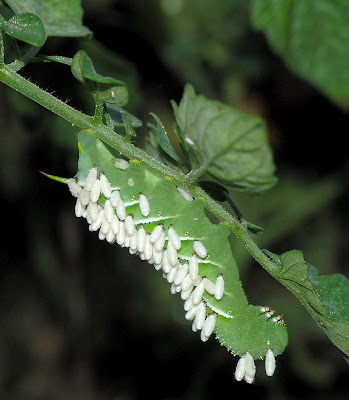
The Tobacco (Tomato) Hornworm (Manduca sexta) shown above is covered with pupal cocoons of a Braconid wasp. The female wasp lays her eggs inside the body of the hornworm. When they hatch the wasp larvae eat the hornworm from the inside out. When the wasp larvae are ready to pupate into adults, they emerge from the hornworm's body and spin these silken cocoons. The Braconid wasps will soon emerge from these cocoons as adults. The hornworn may still be capable of limited movement, but it's innards have been consumed by the wasp larvae and it will soon die.

Hornworms found covered with wasp cocoon should not be killed, but allowed to live -- for just a little while longer -- so the Braconid wasps can complete their life cycle and then paraticize more hornworms.

I have found cocoon covered hornworms a couple of times in the past, but it has been several years. Friday evening I found four paraticized hornworms on one tomato plant. Conditions must be just right for a Braconid wasp population boom.
.

Share/Bookmark

Monday, August 04, 2008

Tomato Hornworm -- Not!


This is the caterpillar I've always called a Tomato Hornworm, but it isn't. True, it is usually found munching on tomato plants, but it is actually a Tobacco Hornworm and is the larvae stage of the Carolina Sphinx moth (Manduca sexta). Host plants include all members of the Nightshade Family (Solanaceae) including potatoes, tomatoes and tobacco. In our garden, I haven't found these caterpillars to be all that picky about what they eat. Tomatoes do seem to be their preferred host, but we've also had them strip pepper plants and I often find them on our Datura (Jimpson Weed).

The primary identifying characteristics for the Tobacco Hornworm are the seven diagonal white lines edged with black and the dorsal horn which is orange, pink or red.

There is a Tomato Hornworm. It is the larvae of the Five-spotted Hawk Moth (Manduca quinquemaculata). Tomato Hornworms look very similar, but have eight V-shaped stripes and their dorsal horn is black.

Caterpillar Legs

All caterpillars have three pair of true legs under their thorax, first body segment behind the head. These legs are jointed, segmented and have little hooks on the end. The are usually used for grasping food. Most caterpillars also have five pairs of prolegs under their abdomen. The prolegs are not segmented, but are cylindrical. They are used for walking and clinging, as they have a set of microscopic hooks on the base (crochets). The last pair of prolegs on the anal abdominal segment are usually called claspers. So, most caterpillars are hexadecapodal because they have a total of 16 legs.

There are many non-hexadecapodal caterpillars, notably the inch-worm type cats, which have six true legs, but only 8, 6 or 4 prolegs. There are also caterpillars with no legs at all. And, there are larvae of some wasps and flies that look like caterpillars, but technically are not. They have more than 16 legs.


Share/Bookmark