Showing posts with label Speyeria cybele. Show all posts

Wednesday, March 02, 2011

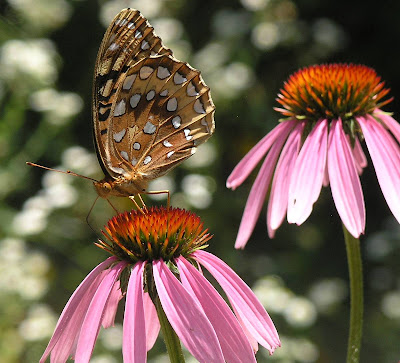
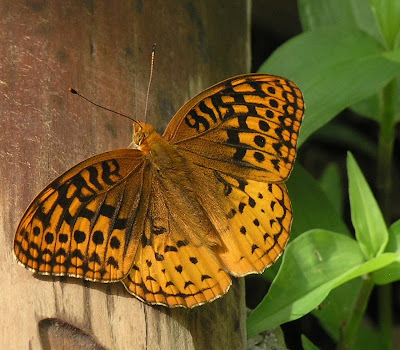
Great Spangled Fritillary (Speyeria cybele)


Great Spangled Fritillary (Speyeria cybele)

From Butterflies and Moths of North America:

Life history: Males patrol open areas for females. Eggs are laid in late summer on or near host violets. Newly-hatched caterpillars do not feed, but overwinter until spring, when they eat young violet leaves.
Caterpillar hosts: Various violet species (Viola).

Adult food: Nectar from many species of flowers including milkweeds, thistles, ironweed, dogbane, mountain laurel, verbena, vetch, bergamot, red clover, joe-pye weed, and purple coneflower.

Habitat: Open, moist places including fields, valleys, pastures, right-of-ways, meadows, open woodland, prairies.

Range: Throughout most of central and northern North America. (See link above for distribution map.)


Join the fun at ABC Wednesday.

.
Share/Bookmark

Sunday, November 08, 2009

Nature Notes: Butterfly weed (Asclepias tuberosa)


Butterfly Weed is a native herbaceous perennial. Though it is a member of the milkweed family it does not have milky-sapped stems.


Butterfly weed is easily grown in average, dry to medium, well-drained soils in full sun. Drought tolerant. Does well in poor, dry soils. New growth tends to emerge late in the spring. Plants are easily grown from seed, but are somewhat slow to establish and may take 2-3 years to produce flowers. Mature plants may freely self-seed in the landscape if seed pods are not removed prior to splitting open. Butterfly weed does not transplant well due to its deep taproot, and is probably best left undisturbed once established.


Butterfly Weed has a long bloom period from late spring throughout the summer. Flowers are a nectar source for many butterflies and leaves are a food source for monarch butterfly larvae (caterpillars).


Great Spangled Fritillary butterflies are among the species attracted to Butterfly Weed by its color and its copious production of nectar.


We hope the Butterfly Weed's wind-borne seeds have a successful journey and establish many more plants for future years.

All photos are by Jo.


.
Share/Bookmark

Thursday, September 24, 2009

Great Spangled Fritillary (Speyeria cybele)


A worn and faded female Great Spangled Fritillary (Speyeria cybele) symbolizes the end of butterfly season is near. She is nectaring on a variety of Blazing Star. (There are many varieties of this colorful fall wildflower. I haven't gotten them all sorted out yet.) The two beetles beneath her are Goldenrod Soldier Beetles (Chauliognathus pensylvanicus), a species of leatherwing beetle that is probably the most commonly seen soldier beetle in eastern/central North America during late summer and fall.


Species information on the Great Spangles Fritillary from Nearctica:

Wing span: 2 1/2 - 4 inches (6.3 - 10.1 cm).

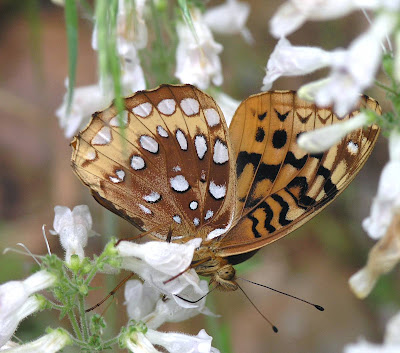
Identification: Large. Upperside of male tan to orange with black scales on forewing veins; female tawny, darker than male. Underside of hindwing with wide pale submarginal band and large silver spots.

Life history: Males patrol open areas for females. Eggs are laid in late summer on or near host violets. Newly-hatched caterpillars do not feed, but overwinter until spring, when they eat young violet leaves.

Flight: One brood from mid-June to mid-September.

Caterpillar hosts: Various violet species (Viola).

Adult food: Nectar from many species of flowers including milkweeds, thistles, ironweed, dogbane, mountain laurel, verbena, vetch, bergamot, red clover, joe-pye weed, and purple coneflower.

Habitat: Open, moist places including fields, valleys, pastures, right-of-ways, meadows, open woodland, prairies.

Range: Alberta east to Nova Scotia, south to central California, New Mexico, central Arkansas, and northern Georgia.


.
Share/Bookmark

Saturday, July 05, 2008

Great Spangled Fritillary (Speyeria cybele)

(Photo taken on 6/25/08)
Great Spangled Fritillary (Speyeria cybele)
Nectaring on Purple Cone Flower.
The Great Spangled Fritillary is our most common mid-summer butterfly.
 
Previous post with more species details.

Share/Bookmark

Thursday, May 29, 2008

Great Spangled Fritillary (Speyeria cybele)


Great Spangled Fritillary (Speyeria cybele)

From Butterflies and Moths of North America:

Life history: Males patrol open areas for females. Eggs are laid in late summer on or near host violets. Newly-hatched caterpillars do not feed, but overwinter until spring, when they eat young violet leaves.
Caterpillar hosts: Various violet species (Viola).

Adult food: Nectar from many species of flowers including milkweeds, thistles, ironweed, dogbane, mountain laurel, verbena, vetch, bergamot, red clover, joe-pye weed, and purple coneflower.

Habitat: Open, moist places including fields, valleys, pastures, right-of-ways, meadows, open woodland, prairies.

Range: Throughout most of central and northern North America. (See link above for distribution map.)


Share/Bookmark