Showing posts with label Wild Comfrey. Show all posts

Monday, May 19, 2008

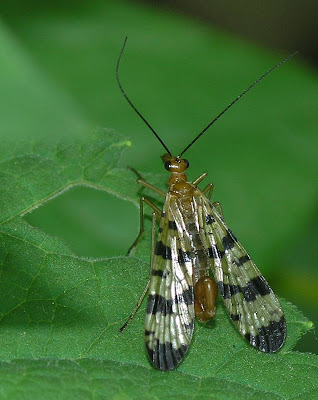
Scorpionfly (Panorpa sp.)


Scorpionfly (Panorpa sp.)

Scorpionflies are neither flies nor scorpions -- aside from that, their common name is totally appropriate. They do look something like a fly (especially a crane fly) and the abdomens of the males curl up over their backs something like the tail of a scorpion. Unfortunately, this male was perched down inside a cave of leaves and I couldn't get a shot from the side which would show the details of this interesting creature. If you want a better look, check out the photos on Cirrus Images.

Both adult and larvae scorpionflies are omnivorous scavangers, feeding upon decaying vegetation and dead (or dying) insects. The are found throughout eastern North America and tend to prefer wet and humid locations.

The mating ritual among scorpionflies involves a food offering made by the male to the female. First the male collects a bit of food -- either a dead insect or a short column of a his brown salivary secretion that has become gelatinous after drying in the air. He flies into a new area with his food offerring and emits a pheromone to attract a female that might be in the vicinity. If the female finds his food offerring worthy, they will copulate while she eats. The duration of copulation depends upon the quantity and quality of the food. Occassionally, males will imitate females in order to secure food from other males.

Sources and additional information:
North Carolina State University
Earth-Life Web
BugGuide


******


Seed Pods
Wild Comfrey (Cynoglossum virginianum)
Related Post


Share/Bookmark

Tuesday, April 29, 2008

Wild Comfrey

Wild Comfrey (Cynoglossum virginianum)

A relatively large native perennial with a small, pale blue flower usually found in open woods. The USDA distribution map indicates wild comfrey is found throughout Canada and central/eastern United States. However, in many of the northeastern states C. virginiauum varies from Endangered to Presumed Extirpated. The heaviest concentration are found mainly in the Mid-South. We have plenty here in the Ozarks.

"The genus name Cynoglossum is from the Greek "cynos", of a dog, and "glossa", tongue and refers to the rough, tongue-shaped leaf. The European Hound's-tongue, a close relative, was believed in ancient times to heal the bite of dogs and to keep dogs from barking. Our native wild comfrey has been used by Native Americans for medicinal purposes." (New York Natural Heritage Program)

There is disagreement about whether this plant actually has medicinal properties or with it was simply incorrectly associated with Old World comfrey. According to the author of 2bn The Wild: "Nineteenth century herbalist suggested that Wild Comfrey (Cynoglossum virginianum) could be a substitute for Comfrey (Symphytum officinale) which is the Old World Comfrey long used for treating wounds and internally for digestive disorders, respiratory infections and as a mild sedative. Pyrrolixidine one of the active substances may cause liver damage it taken in large doses over time. Today some herbalist seem to completely confuse the Wild Comfrey of the U. S. with the Comfrey of Europe and Asia. I can find no scientific data to suggest that they may have the same properties. The more closely related Hound's Tongue (Cynoglossum officinale) was also an Old World plant that was used similarly but there is no evidence of its effectiveness."

"Hound's Tongue (Cynoglossum officinale) is a European species introduced here and now weedy in this country. It is larger and more leafy with reddish purple flowers."

Share/Bookmark