Background: Due to a variety of circumstances more or less beyond our control, Jo and I didn't even begin preparing the beds and planting our garden until after our last spring art fair which was held on the first

weekend in June. Because of our late start, we didn't bother planting some crops -- like corn. We anticipated problems with other crops. We figured the question was: Would the crops produced before succumbing to the prolonged heat and dryness typical of our late summer?
One barely full flat of Yukon Golds is our pathetic potato harvest for 2008. We normally have four or five of those wooden flats heaping full. That question proved irrelevant. The later part of this summer was much cooler and wetter than most. Had I known this in advance, I would have predicted a bumper crop of veggies. I would have been wrong. Some

veggies -- like tomatoes and green beans -- produced well. Others -- like the potatoes we harvested today -- did not do so well. I really do not know why our potatoes produced so poorly. I've heard others also had poor potato yields. Ditto for peppers (bell, jalapeno, etc.) which are usually a "nothing to it" plant to grow.
A half of five gallon bucket of sweet potatoes instead of our normal harvest of 3+ buckets full.As far as conditions unique to our garden that might have contributed to our dismal potato crop: The Yukon Golds never produced the normal amount of foliage. First they were attacked by a heavy infestation of squash bugs sucking out their juices and then blister beetles ate what little foliage the potatoes had managed to grow. Mid-season squash bugs and late season blister beetles seems especially bad the year. Squash bugs aren't usually a problem on potatoes in our garden.

We actually planted fewer sweet potato slips this year. Jo thought she might be planting the sweet potatoes too close together so they competed with each other for nutrients. She experiment by planting fewer potatoes farther apart, thinking each plant might produce more and/or larger potatoes. That experiment was a resounding failure.
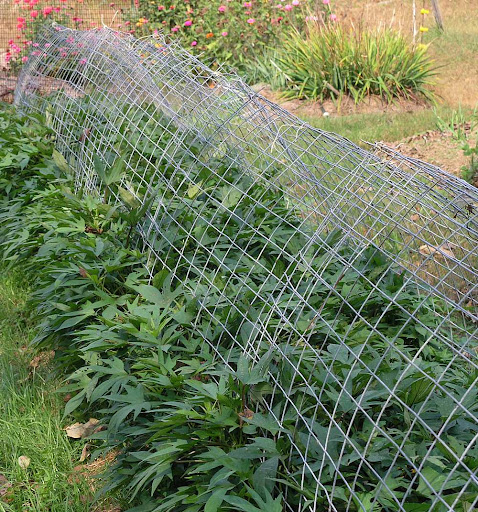
The sweet potato vines were still growing well. The rabbits had even stopped keeping the edges trimmed.
We normally dig sweet potatoes right before the first frost which isn't even in our forecast yet, but we decided to go ahead and harvest them today since the ground is relatively dry and rain is in our forecast. I doubt the potatoes were apt to get any larger or more numerous.Finally, both potato beds were hard to dig because of the tree roots that had grown into them over the summer. Perhaps those roots had robbed nutrients. (Cutting trash trees that have grown up around the edge of the garden is one of this winter's projects.)

While we dug potatoes, a variety of butterflies were enjoying the garden flowers. The zinnias are getting a bit ragged this late in the season, but they are still growing and attracting butterflies.
(Left to right: Monarch, Cloudless Sulphur and Painted Lady)
.

Pathetic Potato Harvest