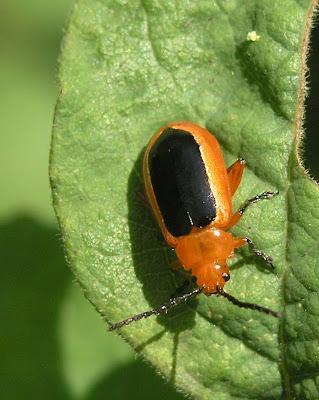
Flea Beetle - Kuschelina gibbitarsa
(Photo: Marvin Smith on 11/14/09)
Flea Beetle General Description: Leaf-feeding beetles with a segment (femora) of the hind legs enlarged for jumping, which they will readily do when disturbed. Adult beetles chew small round or irregularly-shaped holes in plant leaves. Larvae typically feed on plant roots though some also feed on foliage. Many are serious agricultural pests, causing damage directly by plant feeding or indirectly by transmitting viruses. (Note: I suppose the flea beetle pictured here would actually be considered beneficial since it feeds on plants normally considered weeds.)
 Species Identification: Typically four black spots on pronotum (short body segment between head and thorax) ... two spots toward the outer edges and two that blend together in the center ... iridescent green elytra (wing covers) ... approximately 5mm (1/4") long.
U. S. Range: Most of the eastern and central United States.
Host plants: Members of the mint family (Lamiaceae). Here in the Ozarks, I've found large populations of K. gibbitarsa on American Germander (Teucrium canadense).

Kuschelina gibbitarsa larvae on
American Germander leaf.
American Germander leaf.
(Photo: Marvin Smith on 6/25/08)
Comments: The beetle in the top photos was actually found while weeding a strawberry bed. Unfortunately, this bed was invaded by American Germander which we've been fighting for a couple of years. Like most members of the mint family, it is difficult to get rid of once established. K. gibbitarsa overwinter as adults. I'm sure this beetle was attempting to overwinter when we disturbed it with our weeding.

American Germander - Teucrium canadense
(Photo: Marvin Smith on 6/24/08)


This work is licensed under a Creative Commons Attribution-Noncommercial-Share Alike 3.0 United States License.