Showing posts with label frost. Show all posts

Thursday, January 01, 2015

From Frost To Frost Flowers


Monday, 12/29/14:  A heavy frost overnight.  Jo hoped for early morning sunshine so the frost would sparkle, but had to settle for photographing under clouds. 


We did enjoy a partly cloudy sky during the afternoon.  

In the winter one can really see the effects of the 2009 severe ice storm on the trees, both the damaged limbs and the proliferation of new growth trying to compensate for the loss of limbs.

Jo washed a load of clothes and hung them out on our clothesline to dry, but we did not get enough sunshine.  She just left the clothes on the line because they were not dry by evening.

Temperature range:  46°/26°.    29° @ midnight.  No rain today.  2.8" rain for the month.
Summary:  Overcast AM ... cleared to partly cloudy early PM ... light to calm north wind.
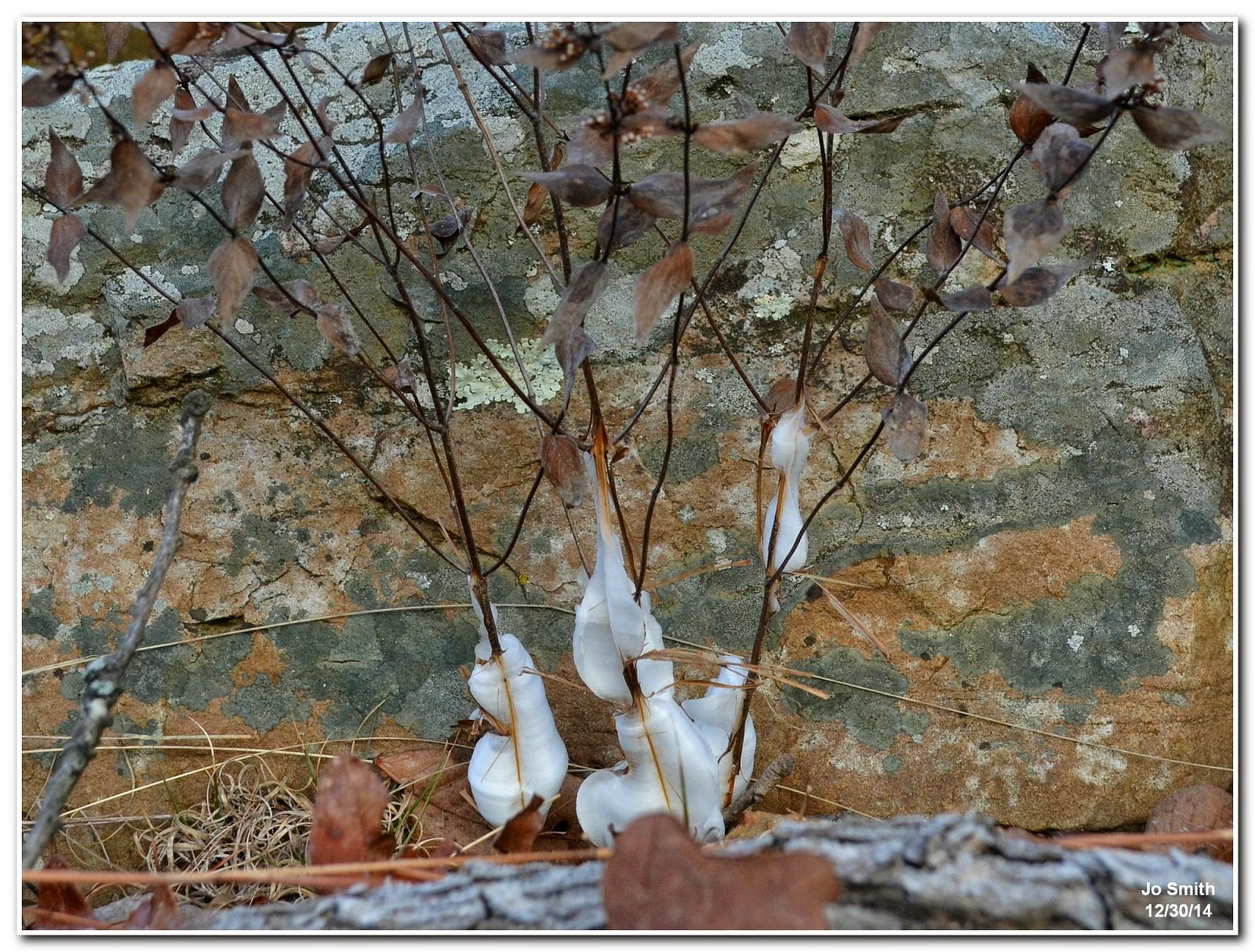


Tuesday, 12/30/14:  Frost flowers on Common Ditney (Cunila origanoides).

Mostly cloudy day, but the clothes on the clothesline did manage to dry.

Temperature range:  34°/24°.    27° @ midnight.  No rain today.  2.8" rain for the month.
Summary: Partly cloudy earlier this morning, but overcast from mid-morning throughout the rest of the day ... light to moderate north wind.

.


Share/Bookmark

Tuesday, January 11, 2011

Nature Notes: Frost Flowers


From a previous post:  Frost flowers occur when the air temperature is below freezing but the ground remains unfrozen.  Here in the Ozarks, that is a fairly common wintertime event.  Our ground never freezes deeply and usually thaws between cold snaps. Some dried weed stems continue drawing moisture up from the ground.  A frost flower forms when water inside a plant stem freezes, expands and is extruded through cracks in the stem forming thin ribbons of ice. Air bubbles trapped in the ice make it appear frothy white. The extruded ribbons of ice are often much more petal-like than the ones pictured here.  Because the stem cracks are irregularly  shaped and the ice pressure inside the stem varies over time, the extruded ice curves and bends.  Like snowflakes, no two frost flowers are ever alike.

Not all plants form frost flowers.  Two of the more common ones that do are yellow ironweed (
Verbesina alternifolia) and white crownbeard (Verbesina virginica). In fact, white crownbeard also is commonly called frostweed.

Another previous post featuring frost flowers, including the shot used to illustrate frost flowers on Wikipedia.


Editors Note (1/13/11):  I'm honored that the frost flowers in this post inspired the following poem by Kris Lindbeck.

You woke up
to frost flowers:
dry weeds
becoming miracles
over one cold night.

Thank you, Kris.

(You can follow Kris on Twitter or visit his blog Haiku etc.)


To participate in Nature Notes and/or see more nature photos, please click the logo above.

.
Share/Bookmark