Showing posts with label nectar. Show all posts

Wednesday, March 18, 2009

Honey Bee (Apis mellifera)

                                                                                                          (Photo taken 03/16/09)


Honey Bee (Apis mellifera) on Cutleaf Toothwort (Cardamine concatenata).  The toothwort is one of the earliest blooming wildflowers in our area.


.
Share/Bookmark

Wednesday, November 12, 2008

Tachinid Fly (Genus Peleteria)


In general, most tachinid flies are relatively large and bristly.  They often mimic wasp or bees.


Adult tachinids feed on pollen and nectar.  Larvae are parasites, preying on other insects -- often caterpillars.  Most tachinids deposit their eggs directly on the body of their host, and it is not uncommon to see caterpillars with several tachinid eggs on them. Upon hatching the larva usually burrows into its host and feeds internally. When fully developed it leaves the host and pupates nearby.   Larvae of Genus Peleteria prey Lepidoptera (butterflies and moths).


There are 1,345 species in 303 genera of tachinid flies in North America.  They can be found practically anywhere and everywhere. Tachinids are often abundant on sunny hilltops looking for mates.


Information source:  BugGuide

.
Share/Bookmark

Tuesday, June 19, 2007

Scaly Bee Fly


Scaly Bee Fly (Lepidophora lepidocera)

Another bee fly. This one nectaring on a black-eyed susan. I don't remember ever seeing one of these until a few days ago. Of course, until I started taking photos of them, I didn't pay attention to most bugs if they weren't trying to suck my blood or sting me.

While the adult scaly bee fly eats nectar, it's larvae is a parasite of solitary wasps. Typically, the female wasp excavates a small burrow in the soil, provisions it with insects she has stung, lays eggs and seals the burrow. The bee fly tries to get her egg into the burrow before it is sealed. When it hatches, the bee fly larvae will consume the developing wasp larvae.

Sources:
Cirrus Images
BugGuide

Share/Bookmark

Monday, June 18, 2007

Sinuous Bee Fly


Sinuous Bee Fly (Hemipenthes sinuosa)

One of the many larger bee flies that frequent flowers and eat nectar (and maybe pollen). Many of the bee flies have a long proboscis but this species does not.

"Sinuous" is based in Latin and refers to the wavy, undulating border formed by the black area on the fly's wings.

Sources:
BugGuide: Sinuous Bee Fly
BugGuide: Family Bombyliidae


Share/Bookmark

Monday, April 23, 2007

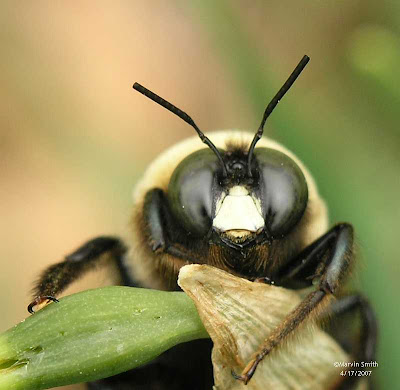
Carpenter Bee


Carpenter Bee (Xylocopa virginica)

Carpenter bees are sometime mistaken for bumble bees since they are about the same size and shape. However, the abdomen of bumble bees is covered with coarse, yellow hairs. Carpenter bees have a hairless, black and shiny abdomen.

After mating the female prepares a nest. If she is constructing a new nest, she uses her strong jaws to tunnel into wood and excavate a gallery where she will lay her eggs. Often the female carpenter been will simply refurbish and/or add to an existing tunnel system. While the female is doing all the work, the male buzzes about noisily, aggressively protecting the nesting area from all intruders. However, the male is all buzz and no sting because only the female has a stinger.

Although they tunnel into wood, carpenter bees do not eat it. Like all other bees, they are nectar feeders and depend upon flowers for their food. Because these large, short-tongued bees cannot get to the nectar in many trumpet shaped flowers, they often engage in a practice called "nectar robbing". That is, they cut into the stem right behind the flower and extract the nectar from there.

Additional Resources:
Ohio State University
University of Kentucky
University of Florida

Share/Bookmark