Showing posts with label pollen basket. Show all posts

Saturday, January 29, 2011

Honey Bee (Apis mellifera)


Although our winter is far from over, we've experience a couple of those unseasonably warm days. Friday the temperature made it up to 70°F. I saw several honey bees, especially in our compost. I suppose the bees (like humans) are drawn out of their hive by this warm weather, and are searching for flowers which they will not find. I don't know if our compost contains sugars the bees can actually use, but the bees are especially attracted to the citrus peels it contains.

(Editors Note:  A reader explained these bees are out of their hive on a cleansing flight.   When the weather is cold, bees "huddle together around the queen (and the honey.)  They slowly rotate from the outside to the center so that no one gets too cold.  At the core of this cluster of bees, workers shiver their bodies and raise the temperature of the cluster as high as 95 Fahrenheit, but just outside the cluster, the unheated portion of the hive may drop below freezing."  When the weather warms the bees "make a cleansing flight to eliminate their body wastes. Honey bees never defecate inside their hive. This is one of their behavioral traits that serve to help prevent disease from spreading through the colony. "  Bees also perform a variety of routine maintenance and housekeeping tasks on the hive on warmer days.  Please check out the two sites I've linked above for more information.  Thanks for cluing me in about cleansing flights , Sue!)


The photo above shows three of the characteristics that help identify this insect as a female (worker) honey bee. One of these is a pollen basket.  Female bees (queens and workers) in family Apidae (honey bees, carpenter bees, bumblebees and several lesser known groups) have specialized structures called pollen baskets (corbicula) used for temporarily storing collected pollen so it can be transported back to the nest/colony. The pollen basket is a smooth, concave structure surrounded by long, stiff hairs located on the tibia of the bee's two rear legs. As the bee visits flowers, she accumulates pollen all over her body. She uses her legs to aggregate the pollen and transfer it to her pollen basket. It may look as if a bee simply has hairy legs, but some of those hairs (setae) are actually combs and brushes used for transferring pollen. The pollen is combed, pressed, compacted, and transferred to her pollen basket. Honey and/or nectar is used to moisten the dry pollen so it will stay in place.  In this photo, her pollen baskets are empty because there are no blooming flowers for her to visit.  A photo of a honey bee with a full pollen basket is here.


To participate in Camera Critters and/or find links to other critter photos, please click the logo above.

.
Share/Bookmark

Saturday, November 28, 2009

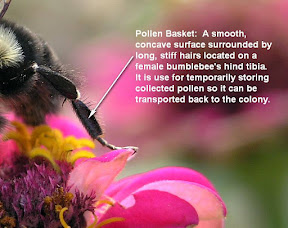
Pollen Baskets (Corbicula)


Common Eastern Bumble Bee - Bombus impatiens
(Photo:  Marvin Smith on 11/8/09)


Most everyone knows that bees visit flowers and collect nectar. Humans value the nectar product and call it honey. Bees also collect pollen. To the bee, pollen is as important as nectar. Pollen is the primary food for developing bee larvae.

Female bees (queens and workers) in family Apidae (honey bees, carpenter bees, bumblebees and several lesser known groups) have specialized structures called pollen baskets (corbicula) used for temporarily storing collected pollen so it can be transported back to the nest/colony. The pollen basket is a smooth, concave structure surrounded by long, stiff hairs located on the tibia of the bee's two rear legs. As the bee visits flowers, she accumulates pollen all over her body. She uses her legs to aggregate the pollen and transfer it to her pollen basket. It may look as if a bee simply has hairy legs, but some of those hairs (setae) are actually combs and brushes used for transferring pollen. The pollen is combed, pressed, compacted, and transferred to her pollen basket. Honey and/or nectar is used to moisten the dry pollen so it will stay in place.


Bumblebee with loaded pollen basket.
(Photo:  Beatriz Moisset via Wikimedia)


While most all bees collect pollen, not all bees have pollen baskets. Many have scopa, a general term referring to a number of different pollen-carrying modifications on the body of a bee. In most bees, the scopa is simply a particularly dense mass of elongated, often branched, hairs (or setae) on the hind leg.


Halictid bee, scopa loaded with pollen.
(Photo:  Beatriz Moisset via Wikimedia )


The bumblebee in the photo at the top of the page is a Common Eastern Bumble Bee (Bombus impatiens), probably the most often encountered bumble bee in eastern North America. It has an unusually long flight season and thrives across a wide range of habitats and climates ranging from the cold temperate zone (e.g., Minnesota) to the warm subtropics (south Florida). B. impatiens can be found in rural, suburban and urban environments. There are isolated pockets of Common Eastern Bumble Bees outside of it's normal range -- like California -- because it escapes from commercial greenhouses where it is used for pollination. The bee has no pollen because this photo was taken in early November when pollen sources were few and far between. She was lucky to find a few scraggly zinnias still blooming in our garden.

Sources and links:
Bombus impatiens on BugGuide
Pollen Basket on Wikipedia
Scopa on Wikipedia
Bumblebee legs on Bumblebee.org


.
Share/Bookmark