Showing posts with label spider. Show all posts

Monday, October 24, 2011

Banded Argiope Spider (Argiope trifasciata)


The large orb-weaver spiders are probably the most often seen spiders in the fall. They've been around all summer, but by fall, the females are large and often construct their webs in conspicuous locations. The garden spider I most often see is the Black & Yellow Argiope (Argiope aurantia) seen here in a previous post. The spider above is a close relative, the Banded Argiope (Argiope trifasciata). Their web is similar in size and shape to that of the yellow garden spider, but it is not uncommon for the stabilimentum (the white zig-zag area) to be absent or have variability in shape.


.
Share/Bookmark

Saturday, October 24, 2009

Marbled Orbweaver (Araneus marmoreus) - Female


A common orbweaving spider found throughout most of North America. This individual is a female. Males are about a quarter the size of females.

From Ohio State University:

Polymorphic - This spider has many color varieties. The most common form has an orange front part of the body (cephalothorax) with orange/white/black banded legs. The abdomen on this form is either orange or yellow with a pattern that resembles a face to some observers. Other color varieties include one that is very pale tan or yellow, sometimes with a black spot in the middle of the abdomen. (Photos of different color variations are available on BugGuide.)

Harmless - This species, as is common to members of the orbweaver family, is not known to bite humans. It preys on a variety of flying insects.


Nocturnal - The spiders build their web at dusk and either wait in the web or in a retreat near the web at night for prey to strike the web. Then the spider runs out and wraps the prey in silk. After the prey is immobilized, the prey is bitten and eventually eaten. Some individuals stay in their webs during the day, but this is not common. They typically rebuild their web each day, or at least the sticky spiral orb part.

Jo and I found this spider while on our afternoon walk. It was in the middle of the road dangling from a single web strand and swinging back and forth. Photographing was difficult. Many thanks to my photographic assistant wife for enticing the spider onto a stick and then manipulating the stick so I could take a few photos.


Creative Commons License


.
Share/Bookmark

Wednesday, September 02, 2009

Spider versus Mud Dauber


It really wasn't much of a contest. The Black and Yellow Mud Dauber's (Sceliphron caementarium) only hope was escaping from the Cobweb Spider's (Family Theridiidae) web -- and she could not.


Creative Commons License

.
Share/Bookmark

Tuesday, September 01, 2009

Whitebanded Crab Spider (Misumenoides formosipes)


Crab spiders are ambush predators. They sit in strategic locations, waiting for prey to arrive. Some species of crab spiders have evolved to blend in with bark and leaf litter. Others are more brightly colored and "hide" in flowers.

Typically a female crab spider lays her eggs in the fall and they hatch the following spring. The spiderlings spend the summer eating and growing. They will eat just about any insect that happens to come within the grasp of their powerful forelegs (including other spiderlings). By late summer and fall, the mature crab spiders become more conspicuous. Most of the crab spiders you see are females. Males are much smaller and marked differently.

Researchers say the venom of some crab spiders is more potent than most other spiders. This allows the relatively small spiders to quickly immobilize much larger prey. However, crab spider venom is not know to be especially harmful to humans, and unless you trap a crab spider in your hands and began squashing, you're highly unlikely to be bitten in the first place.

Most sources say crab spiders can slowly change their color to match their surroundings, although one claims that color is determined by where the females lays her eggs. I don't know, but I find it much easier to believe a crab spider can slowly adapt its color to its surroundings.

One thing I've noticed, but didn't find mentioned is that crab spiders often curl over a petal or two on a composite flower to help conceal themselves.

Three genera of flower crab spiders are common in North America. They can be a little tricky to identify because all three look similar and there can be considerable variation in color and markings within each genus. The ultimate determining factor in identifying these crab spiders is the position of their eight eyes. BugGuide has and excellent comparison article for helping with identification.


Both of the spiders on this page are Whitebanded Crab Spiders (Misumenoides formosipes). The identifying characteristics are: The white ridge across the spider's face just below its eyes. (Another common name for this species is Ridge-faced Flower Spider.) The forward-pointing, V-shaped marking on the spiders abdomen. The eyes: When viewed from the front and slightly above only six eyes are visible. Four are more or less in a row right above the white ridge. Two are above the four. The spiders other two eyes are at the ends of the top ridge and are actually on the sides of the spider's "head". (BugGuide has a photo showing eye placement more clearly than mine.)

Sources and Additional Information:
University of Kentucky Entomology
Missouri Spiders


Creative Commons License

.
Share/Bookmark

Thursday, August 27, 2009

Yellow Garden Spider (Argiope aurantia)


Robber flies aren't always predators. Sometimes they can be prey, like this one captured by a female Yellow Garden Spider (Argiope aurantia)


Creative Commons License

.
Share/Bookmark

Monday, July 13, 2009

Jumping Spider


Jumping spiders have a very distinctive, flat-faced, big-eyed appearance that is difficult to confuse with other kinds of spiders. They also have a unique, herky-jerky way of moving. Most are small and hairy. Like all spiders, jumping spiders have 8 legs, 2 body parts, and no antennae. Eight eyes are present on jumping spiders, although 1 pair is often so small that it appears as though there are only 6 eyes. One pair of eyes is always very large and directed forward, almost like human eyes.

Jumping spiders do not build a web to catch prey. Instead, they use their silk in a different way. When jumping spiders jump, they always attach a silk line. That way, if they miss their target they they can climb back up and try the jump again.

Jumping spiders are among the fastest creatures in the arthropod world. Their speed and keen eyesight allow them to pounce on flies, crickets, and even other spiders with amazing accuracy. A resent study showed jumping spiders can remember the exact location of their prey even when they cannot see it. They can locate prey, move closer behind cover and still jump on the prey without ever reconfirming its location.

Source: University of Kentucky Department of Entomology.

This is probably a jumping spider in the genus Phidippus.

.

Share/Bookmark

Thursday, July 24, 2008

Black & Yellow Argiope (Argiope aurantia)


Black & Yellow Argiope (Argiope aurantia)


Probably the most common orb-shaped web spider in North America. Other common names include Yellow Garden Spider, Golden Orb-weaver, Yellow Garden Orbweaver and Writing Spider. A. aurantia range throughout most of temperate NA, south through Mexico and into Costa Rica. The black and yellow color pattern can vary considerably between individuals.

Like most orbweavers, these spiders first appear and begin constructing webs in the spring. However, they are often not noticed until fall when they and their webs are much larger and conspicuous. The Argiopes you see are almost always females. They are considerably larger than males. Males spend most of their lives wandering in search of a receptive female and spend little time on the web once she is found. If they are fortunate enough to escape becoming a post-mating protein supplement for the female, they die shortly after breeding anyway.

These orbweavers almost always construct a conspicuous white zigzag pattern (stabilimentum) into their webs. It is a distinctive characteristic of this species. Juveniles often enlarge the zigzag into something of an oval. Some believe this helps camouflage the young spider. You sometimes see the web of Argiopes vibrating rapidly back and forth. It doesn't look as if the spider is causing the vibration, but she is. She uses the vibration to check for prey in her web.


BugGuide links:
Family Araneidae
Genus Argiope
Species Argiope aurantia


Share/Bookmark

Friday, July 11, 2008

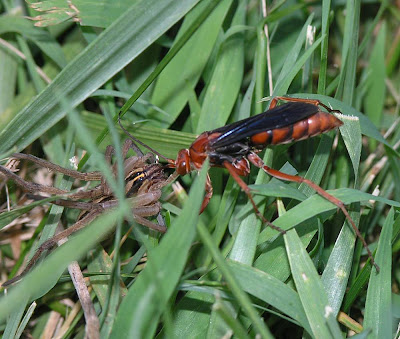
Spider Wasp (Tachypompilus ferrugineus)


A common wasp often found in open areas (old fields, meadows, prairies and woodland edges) throughout most of North America.  Adults feed on nectar/pollen.  Females provision their nest with spiders, usually Wolf Spiders (Family Lycosidae). 

A female captures and paralyzes prey prior to constructing a nest.   She then drags the spider back to the nesting area.  I do not know where this female captured her spider or the location of her nest, but she dragged the spider through the garden for about fifty feet while I was watching.  A couple of times one of the dogs wandered too close and she abandoned the spider.  However, both time she returned after several minutes and resumed her arderous journey.

Nests are constructed in a crevice or at the base of a rock pile, walls, or building.    The female scoops out a shallow depression in the soil, deposits prey and then lays her eggs.  She covers the nest with soil and debris.

Thanks to Nick Fensler on BugGuide for the ID.


Share/Bookmark

Tuesday, July 24, 2007

Garden Spider


Black & Yellow Argiope (Argiope aurantia)

One of the most common orb weaving spiders. We have several at various places in the garden. BugGuide has an information page with many photos illustrating this spider's life cycle.
Share/Bookmark

Wednesday, July 04, 2007

Fishing Spider


Whitebanded Fishing Spider - Dolomedes albineus

As their name implies, fishing spiders are most commonly associated with water. Some species will almost always be found in or near the water. (They can walk on the water or dive under the surface when they want.) Other species of fishing spiders -- like this Whitebanded found on our porch -- range farther afield. None build webs to capture their prey, but rely on speed, stealth and their large size for successful stalking of food. This particular spider did quite well at capturing a moth under our porch light.


The fishing spiders are members of a larger family called Nursery-Web Spiders (Pisauridae). The female carries an egg sac containing hundreds of eggs. Shortly before the eggs are due to hatch, she removes the egg sac and attaches it to vegetation. Then, she builds a nursery web around the sac to help protect the newborn spiders, and stands guard nearby. The young spiders live in the nursery web for quite some time after hatching.

Source: University of Arkansas Entomology
Share/Bookmark

Monday, June 25, 2007

Striped Lynx Spider


Striped Lynx Spider - Oxyopes salticus - Male

These little spiders do not build webs. Instead, they rely on their speed and agility to catch prey. Hence, the family name "Lynx". They may be quick and agile, but don't even come close to reminding me of a lynx.

More info at BugGuide.
Share/Bookmark

Sunday, June 24, 2007

Black Widow Spider


Northern Black Widow - Latrodectus variolus

The other day on our afternoon walk with the dogs, I ventured off into the weeds at the side of the road while trying to chase down an insect. When I returned, Jo noticed this black widow crawling up my sock. Around the house I usually wear cutoff jeans, sneakers and over-the-calf socks. It's quite a fashion statement, but the high socks help protect my lower legs from bugs and brambles since I'm prone to wandering off into the weeds with our camera.

Jo used a rock to brush the spider off my leg before she crawled up my leg and into the cutoffs. (There's never a stick around when you need it, but we've got plenty of handy rocks.) If the black widow had gotten trapped between me and my cutoffs, I'd probably have gotten bitten, an event not likely to be life threatening, but painful enough to avoid. Once we got the spider back onto the ground, I took some photos.

Unfortunately, I failed to flip the spider over and get a shot of her abdomen. That's where the "hourglass" design that signifies a black widow is located. In a Southern Black Widow, the two halves are connected; in a Northern species they are not. One of the people at BugGuide who specializes in spider said he thought this one was a Northern species.

Another feature that identifies this spider as a black widow is that the third pair of legs is short. They have combs at the end and the spider uses there for wrapping webbing around her prey.

Incidently, the old wives tales about a black widow eating her mate is only partially true. Yes, black widows do sometimes eat their mate, but getting eaten is an occupational hazard for male spiders of many different species.
Share/Bookmark