Showing posts with label wildflowers. Show all posts

Sunday, February 20, 2011

Macro Monday: Johnny-Jump-Up


Heinz thought she was referring to ketchup.
She told NPR the song was about waiting on Cat Stevens,
AKA:  Steven Demetre Georgiou
AKA:  Yusuf Islam

No matter.

My anticipation is spring
and early spring wildflowers 

"Anticipation, Anticipation
Is making me late
Is keeping me waiting." 


Join the Macro Monday fun at Lisa's Chaos.
  

.
Share/Bookmark

Wednesday, April 16, 2008

Fire Pink


Fire Pink (Silene virginica)
(photo by Jo)

Habitat: Rocky woods, ledges, wooded slopes.

Origin: Native to U.S.

Range: Eastern North America, except for the extreme northeast.

Comment: The "pink" in this wildflower's name has nothing to do with color. Instead, it refers to the notches at the end of the petals. The petals appear to have been pinked.


Share/Bookmark

Monday, April 14, 2008

Texas Trip -- Randomly

A few random photos to wrap up our recent trip to the Texas coast.

Roadside bluebonnets, the Texas state flower. (Photo by Jo)


Mom's Amaryllis


I really don't see why Mom didn't plant a redder hibiscus.


We visited a little too late to see the peach blossoms.


Indian Blanket


The bees were abuzzin.


Primrose (Photo by Jo)

Share/Bookmark

Monday, March 31, 2008

Dutchman's Breeches


Dutchman's Breeches

My best shot at an ID: Dicentra cucullaria
Plant family: Fumariaceae (Fumitory - Bleeding Heart)
Habitat: Rich moist woods, shaded ledges and banks, especially north slopes. Locally abundant especially the mountains.
Range: North Dakota to Quebec and south as far as northern Georgia. Very scattered locations in the southern part of range. Also found in a few northwestern states.
Plant Type: Native perennial.
Flower description: The flowers are irregular in shape and are up to 1.75cm long (0.7 inches). Flowers actually have 4 petals, the inner ones are very small. The pair of outer petals form a swollen 'V' making the hanging flower look like a pair of breeches hung upside-down.
Lore: Native Americans used Dutchman's Breeches as a love potion and in making love charms.


We are pretty much at the southern limit of this unusual little flower's range. Jo and I have only found it growing in one location in the area we normal frequent. It's abundant exactly where the guide books say it should be: A rich woodland shaded by a ledge on a north slope, although I don't know how rich and loamy the soil is in ledge crevice where the individual shown above is trying to grow.


Share/Bookmark

Saturday, March 29, 2008

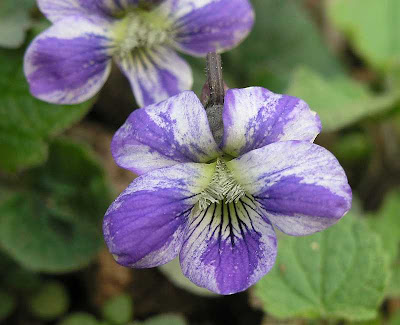
Johnny-Jump-Up


Johnny-Jump-Up

Other Common Names: Field Pansy, Wild Pansy
My best shot at an ID: Viola bicolor (Pursh)
Plant family: Violaceae (Violet)
Habitat: Fields, waste ground, disturbed sites, meadows, roadsides, railroads, lawns (just about any open area)
Range: Throughout most of eastern and central North America and into western Canadian provinces
Plant Type: Native annual
Description (from Illinois Wildflowers): Each flower is about ½" across, consisting of 5 petals and 5 sepals. The petals are pale to medium blue-violet with dark purple lines, becoming white near the throat of the flower. However, the lowermost petal has a patch of yellow near its base. Also, the two lateral petals are bearded with white hairs near the throat of the flower.
Lore: Native Americans used Johnny-jump-up to treat colds, coughs, headaches and boils. It was also used to prepare a spring tonic.


Getting an ID on this little flower was more difficult than I expected, especially since I started out thinking that I knew what is was. It has three scientific name synonyms. Some sources attribute it's common name to a different plant. And, there is disagreement about whether V. bicolor is native or not. (The USDA says it is native.)

Johnny-Jump-Up spreads by seeds and is usually found in clusters. We have several patch in our yard and garden. Illinois Wildflowers says it is sometimes used as one of the parents of pansy cultivars developed for the mass market.


Share/Bookmark

Sunday, March 23, 2008

Easter Sunday in the Woods


The Dog-Tooth Violet (Trout Lily) blooms are just starting to open.


The Trillium blooms will be opening very soon.

Share/Bookmark

Sunday, March 16, 2008

Bluet


Less than a week after our last snow (I hope it was, indeed, our last snowfall of the winter), wildflowers are beginning to appear. On Thursday I noticed a few dozen of these tiny bluets (Houstonia pusilla, I think) scattered around the pasture. By Friday, there were several hundred scattered in various places, and many were beginning to emerge in small clusters which is typical for the species. A single small bluet -- a purple-blue flower 1/4-1/3 inch across -- is easy to miss, but a cluster adds a splash of color to the glades, rocky ledges, outcroppings and dry open places where they typically grow. Bluets are native annuals that seem to do a very good job of reseeding themselves.

Another sign of spring that we've been experiencing is thunderstorms. Storms on Thursday evening knocked out our ISP for about 18 hours. More storms Friday night took out our telephone service while I was in the process of making a blog post. Doing anything online has been a challenge the past few days.
Share/Bookmark

Sunday, July 08, 2007

Sand Mystery


Black-eyed Susan (Rudbeckia hirta)

A few weeks back, Jo discovered this unusual Black-eyed Susan alongside our road out. We'd never seen a Black-eyed Susan with the red-brown color on the petals. After a bit of online research, we finally concluded that there is a great deal of variability in these flowers. The Ladybird Johnson Wildflower Center has a page of Black-eyed Susan photos that shows a wide variety of shapes, petal numbers and colors, including ones like "ours". This variation is normal if not common.

Even though we knew that seeds saved from this plant probably would not produce a new plant with the same color pattern, we decided to save the seeds anyway just to see what happened. Jo marked the plant with a stake with a bit of surveyor's tape wrapped around its top. She figured we'd collect the seeds when they'd dried. Little did we know that her marker would be interpreted as meaning "dump sand here".


I really don't know the whole story about why the sand came to be dumped on top of the wildflowers. All I know is this: Friday morning our neighbor's son, Halan Dean, drove down to ask if we'd ordered any sand. A guy with a dump truck load of sand was up at the top of the hill, but for some reason he wasn't clear as to who'd ordered the sand or where it needed to be delivered. Halan drove down to ask if it was ours in order to save the driver (and us) the hassle of getting a big truck turned around in our yard if we hadn't placed the order, which we had not. That's all I know. Why the sand was eventually dumped alongside the road in the woods, I don't know. I also know that the Black-eyed Susan with the red-tinted petals us underneath that sand pile.
Share/Bookmark

Saturday, June 23, 2007

Indian Hemp


Indian-hemp (Apocynum cannabinum)

Other common names include Dogbane and Hemp Dogbane. Native to the U.S.

The strong, erect, purplish stem of Indian-hemp rises 3-4 ft., with branches ascending from the upper part. Long oval leaves often have a white coating or bloom as found on plums. Small cream-colored flowers are clustered at branch ends or on stalks from leaf axils. Tufted seeds form in spindle-shaped pods.

A. cannabinum is used as "Hemp", made from the twisted fibers of the plant.

Habitat - Open woods, pastures, waste ground, disturbed sites, wooded slopes, roadsides, railroads.

Sources:
LBJ Wildflower Center
Missouri Plants

Share/Bookmark

Friday, June 22, 2007

Tickseed


Tickseed (Coreopsis palmata)

According to the Missouri Botanical Garden: Easily grown in dry to medium wet, well-drained soil in full sun. Thrives in poor, sandy or rocky soils with good drainage. Tolerant of heat, humidity and drought. Spreads by rhizomes and self-seeding, and in optimum growing conditions will naturalize to form large colonies.

There is a patch of tickseed growing at the top of the first hill along our road out. That spot definitely qualifies as open and rocky.

Plants in the genus coreopsis are often commonly called tickseed in reference to the resemblance of the seeds to ticks.

(A couple of Tumbling Flower Beetles included at no extra charge.)

See also: Missouri Plants
Share/Bookmark

Tuesday, June 12, 2007

Moth Mullein


Moth Mullein (Verbascum blattaria)

A biennial that can grow as tall as five feet and have either white or yellow flowers. Moth mullein is found throughout most of the United States and grows in fields, pastures, roadsides and other disturbed or abandoned areas. This plant is growing in the garden next to the strawberries, and will have to be removed soon. We've also found the yellow variety down in the woods.

Several online sources (including the USDA) say that moth mullein is an introduced species. Missouri Plants says it is native. I dunno.

Additional Resources:
Virginia Tech Weed ID Guide
Missouri Plants
2bnthewild


Share/Bookmark

Friday, May 04, 2007

Carolina Cranesbill


Carolina Cranesbill (Geranium carolinianum)

Some might call this variety of wild geranium a weed, and it does come close to qualifying for that description. It will grow well virtually everywhere and usually does. Fields, gardens, vacant lots and idle land are among its favorite locations. But weed or not it does have a pretty little (1/4 - 3/8 of an inch) purple flower and its seeds furnish food for quail, turkeys and doves.

See also:
Wildflowers of Western Kentucky
Missouri Plants
Kansas Wildflowers and Grasses

Share/Bookmark

Wednesday, May 02, 2007

Spiderwort


Spiderwort (Tradescantia virginiana L.)

I'm not 100% sure of species. As Neartica says: There are a number of other species of Tradescantia in eastern North America. These species can be difficult to separate from T. virginiana.

Growing on the bluff at the base of the trail off Jerry Joe's north pasture. Also alongside the trail as you enter the woods.

See also: Missouri Plants
Share/Bookmark

Tuesday, May 01, 2007

Blackberry Bloom


The blackberries seem to be blooming heavily this year. This particular one happens to be on the hill in the garden.
Share/Bookmark

Sunday, April 29, 2007

Blackhaw Viburnum


Blackhaw Viburnum (Viburnum prunifolium)

We have a couple of specimens growing along the edge of the woods north of the house.

Black haw is usually grown as a large, upright, multi-stemmed, deciduous shrub with an irregular crown, but it also may be grown as a small, single trunk tree. As a shrub, it typically grows 12-15' tall with a spread of 6-12', but as a tree may reach a height of 30'. Commonly occurs in moist woods, thickets and on streambanks. Non-fragrant white flowers in flat-topped cymes (to 4.5" diameter) appear in spring. Flowers give way in autumn to blue-black, berry-like drupes which often persist into winter and are quite attractive to birds and wildlife. Ovate, finely toothed, glossy dark green leaves (to 4" long) turn attractive shades of red and purple in fall. Fruits are edible and may be eaten off the bush when ripe or used in jams and preserves. Common name refers to the purported similarity of this plant to hawthorns (sometimes commonly called red haws), though hawthorns are in a different family.

Source: Missouri Botanical Gardens
Also: Missouri Plants

Share/Bookmark

Friday, April 20, 2007

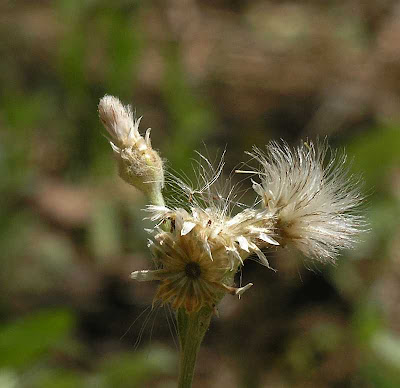
Pussy Toes

Photo by Marvin
April 5, 2007


Pussy toes is another wildflower that thrives in less than prime growing conditions, growing well in rocky, disturbed and run down areas. It is a member of the aster family. Some think the flower clusters resemble a cat's paw and that is the reason for the common name of "pussy toes". A photo from Illinois Natural History Survey illustrates the resemblance better than mine. When the pussy toes' seeds are mature, they are carried away by the wind.


Additional Resources:
Missouri Plants
Illinois Plant Information Network
Share/Bookmark

Monday, April 09, 2007

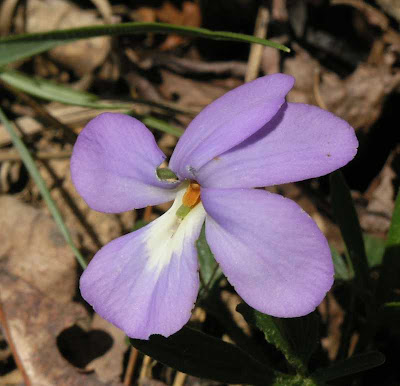
Bird's Foot Violet

Photo by Marvin
April 5, 2007

Bird's Foot Violet (Viola pedata)

Unlike most of our wildflowers, Bird's Foot Violet prefers rocky and/or dry woods, slopes and ridges. It's growing in and along the old road around the bench, almost back to the house on our routine afternoon walk loop.

There are two varieties of this violet other than the one pictured above. One has two petals that are much darker purple and is often called a Pansy Violet. Here, those bloomed a little earlier in the spring. Another variety is white, but we haven't discovered any of those on our place. Like all violets, Bird's Foot can hybridize easily in the wild. Unlike most violets, Bird's Foot has no cleistogamous flowers, making it impossible for this species to self-pollinate.


Cleistogamous flowers are flowers that do not open and are self pollinated. Cleistogamy insures that a plant produces seeds, even if conditions are unfavorable for wind or insect pollination. Cleistogamy occurs in many different and unrelated plant families, including violets (Violaceae), rushes (Juncaceae) and grasses (Poaceae).

Additional Resources:
Discover Life
Missouri Plants
Missouri Botanical Garden


Share/Bookmark

Sunday, April 08, 2007

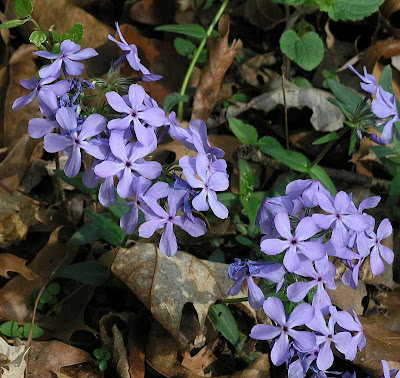
Phlox

Photo by Marvin
March 29, 2007


Phlox (Phlox divaricata)

Phlox (Phlox divaricata) is by far our most common woodland wildflower during the spring, both in terms of quantity and length of bloom. Blue Wood Phlox have already been blooming for three or four weeks.

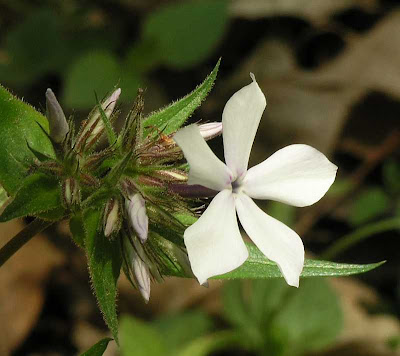
According to the ID guides I found online, the white phlox below is the same genus and species. The white variety is much less common, and the plants that I've found are growing as individuals, not in the clusters common to Blue Wood Phlox.

Photo by Marvin
April 5, 2007

Additional resources:
Missouri Plants (blue)
Missouri Plants (white)
Kansas Wildflowers and Grasses (blue)
Share/Bookmark

Saturday, April 07, 2007

Purple Wood Sorrel

Photo by Jo
March 29, 2007

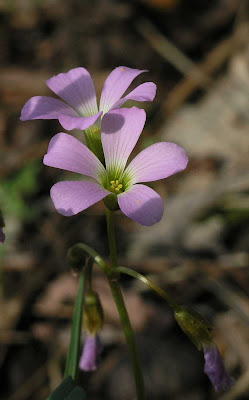
Purple Wood Sorrel (Oxalis violacea)

Both purple and yellow wood sorrel are found here, though yellow is more common. Some people like to use wood sorrel as a salad garnish because of it's sour taste, but it should be eaten in moderation if at all. The leaves and stem contain oxalic acid which can cause kidney damage.

This cluster of wood sorrel we found growing on a bluff rock top beside the path down from Jerry Joe's pasture north of our place.

Additional information links:

Missouri Plants
Kansas Wildflowers and Grasses
Share/Bookmark

Friday, April 06, 2007

Common Blue Violet

From Photo by Jo -- March 26, 2007

Most of the common blue violets we have are dark purple, but we've found a few with variegated petals. Petal color can vary from dark purple to nearly white, and the common violet easily hybridizes with other violet species in the wild.

Links with additional information:
Missouri Plants
Missouri Wildflowers
Share/Bookmark