Showing posts with label beetle. Show all posts

Wednesday, July 22, 2015

American Carrion Beetle (Necrophila americana)


American Carrion Beetle
 (Necrophila americana)

Life cycle (BugGuide): Eggs laid singly on/near carrion. Larvae hatch in a few days, feed in or under carcass, and pupate in a nearby soil cell. Adults overwinter.

.

Share/Bookmark

Monday, July 13, 2015

Brown Prionid (Orthosoma brunneum)


Brown Prionid 
(Orthosoma brunneum)

Larvae feed on rotting wood, usually fallen logs and tree stumps. Adults attracted to light.

.

Share/Bookmark

Sunday, November 04, 2012

Multicolored Asian Lady Beetle (Harmonia axyridis)


Multicolored Asian Lady Beetle (Harmonia axyridis)

Warm fall temperatures are bringing out many of these Asian invaders. 

For more details, please see BugGuide.


Share/Bookmark

Saturday, June 09, 2012

Longhorned Beetle (Purpuricenus humeralis)


Habitat: Forests in eastern North America.

Food: Larva bore into dead branches of various hardwoods.

Source: BugGuide.
Share/Bookmark

Sunday, October 16, 2011

Locust Borer Beetle (Megacyllene robiniae)


Identification: Adult beetles are black with yellow stripes across. The third stripe on the elytra is W-shaped.

Habitat: Anywhere Black Locust trees are present - most of the US.

Season: Adults most noticeable in September when Goldenrod comes into bloom.

Food: Larvae feed exclusively on Black Locust tree and its cultivars (Robinia pseudoacacia). Adults feed on pollen, particularly Goldenrod (Solidago).

Life Cycle: Eggs are laid in locust trees in the fall. Newly emerged larvae spend several months in tree trunks, first hibernating through the winter under the bark, then tunneling into trees in spring, eventually making tunnels about 4" long and .25" inch wide. They pupate late July/early August. Adult beetles emerge late August to September.

(From BugGuide)

.
Share/Bookmark

Sunday, March 27, 2011

Banded Hickory Borer (Knulliana cincta cincta)


Banded Hickory Borer (Knulliana cincta cincta)

Longhorned Beetle (Cerambycidae)

Range: Eastern North America to western Texas, south to northern Mexico..

Food: Larvae feed on dead and seasoned branches and limbs of hardwood species, including oak and hickory.

Life Cycle: Eggs are laid in crevices in the bark, or directly into the wood. Larvae feed the first season beneath the bark, then head deeper into the wood.

Identification:   Markings may be absent.  Prominent spines on sides of the pronotum and at the elytra apices. The scutellum is considerably longer than broad.  There are no other NE longhorns of similar size and coloration that have strong spines on the femora, pronotum, and elytral apices.

Last week -- prior to our weather's return to winter-like conditions -- these longhorned beetles were numerous under our porch light.


Join the Macro Monday fun at Lisa's Chaos.

.
Share/Bookmark

Monday, March 14, 2011

Longhorned Beetle (Stenosphenus notatus)


Longhorned Beetle
(Stenosphenus notatus)

Identification: Combination of red pronotum with black spot and shiny black elytra with white hairs is distinctive.

Range: Eastern North America, west to Rocky Mountains.

Habitat and Food: Larvae feed in dead limbs of various hickories. Found in decidious forest with these host species.

Remarks: Most wood boring beetles overwinter as larvae. When warmer spring weather arrives, they develop into adult beetles and emerge in the late spring or early summer. S. notatus is different. Adult beetles develop in the fall, but overwinter inside the wood, finally emerging in the very early spring. (Source:  Ted MacRae @ Beetles in the Bush)  This particular beetle had actually not yet emerged. I found it inside a piece of hickory I split for firewood.


Join the Macro Monday fun at Lisa's Chaos

.
Share/Bookmark

Sunday, January 09, 2011

Round-headed Apple Tree Borer (Saperda candida)


The round-headed apple tree borer (Saperda candida) takes 2-3 years to complete its life cycle. Adult beetles are 1 inch long and brown, with two white longitudinal stripes on its back. Larvae overwinter in various stages feeding on sapwood and heartwood. Pupation occurs in late spring of the second year, and emergence begins in early summer.  Females lay eggs under bark scales, in crevices, or in tree wounds. After hatching, the larvae feed beneath the bark for a while before entering the wood.  Feed on dead or dying trees and rarely on healthy trees.  Trees become weakened and heavy infestations can kill a tree in one season. Members of the rose family are favorite hosts of the round-headed apple tree borer.  Found mostly in the eastern US and Canada.  (Source:  The Morton Arboretum)


Round-headed Apple Tree Borer Larva


To participate in Macro Monday and/or see other great macros on a variety of subjects, please click on the logo above.


An Inordinate Fondness is a celebration of beetles—of their indescribable beauty, amazing forms, and astonishing diversity. For a list a past, present and future An Inordinate Fondness blog carnivals, please click on the logo above.


.
Share/Bookmark

Saturday, July 31, 2010

Gold-and-brown Rove Beetle (Ontholestes cingulatus)


Gold-and-Brown Rove Beetle (Ontholestes cingulatus)

A relatively large rove beetle found throughout most of North America.  Adults eat maggots, mites, and beetle larvae.  Typically found in woodlands and wherever carrion occurs.  Several have been checking out our compost lately.

.
Share/Bookmark

Saturday, March 13, 2010

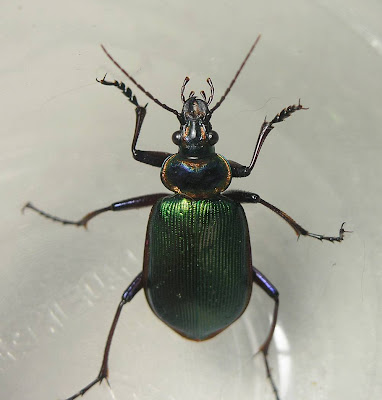
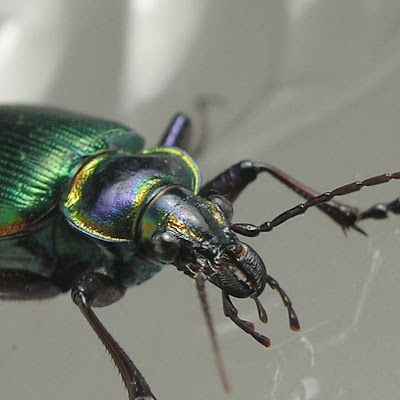
Fiery Searcher (Calosoma scrutator)

Photo taken 7/7/08
.
.
Fiery Searcher (Calosoma scrutator)
.
This brilliant, metallic green beetle is sometimes found in large numbers during the Arkansas spring, being attracted to lights at night. It may cause alarm because of its large size (it reaches 1 - 1½" in length) and the odor it emits to ward off predators and intruding humans. The wing covers have many fine longitudinal furrows that are beset with tiny punctures, and each cover has a reddish-copper border. The head, pronotum, and legs are deep metallic blue or purple, and the pronotum has a gold margin. Imprudent handlers could receive an unwelcome nip from the hefty mandibles. However, Calosoma scrutator is a highly beneficial species that climbs trees in search of caterpillar prey. Although the beetles are active from May to November, they seem to be especially numerous in May after trees are fully leaved out and while the spring flush of caterpillars is ravaging the foliage. Adults winter over, and they live up to 3 years. Eggs are placed one at a time in soil. Larvae also hunt caterpillars and climb trees and shrubs in search of prey. They pupate in earthen cells.

 
.

(Originally posted on 9/5/08)


.
Share/Bookmark

Monday, February 15, 2010

Eyed Click Beetle (Alaus oculatus)

OTHER COMMON NAMES:  Eyed Elater, Eastern Eyed Click Beetle.

SIZE:  Around 1 1/2 inches (40mm).

FOOD:  BugGuide says adult beetles may take some nectar and plant juices.  Larvae are predatory.

The larvae of most click beetles are called wireworms.  Several feed on plant roots and can be serious agricultural pests.  However, the Eyed Elater larva is a meat-eater that feeds on many other noxious larvae, including those of wood-boring beetles, flies, and other undesirables. The large larva (up to two inches) has two powerful jaws to aid in disabling and dismembering prey.

LIFE CYCLE:  Eggs are laid in soil.  Larvae are usually found in decaying wood, under logs and other dark, damp places.  The Eyed Elater spends most of its life in the larval form, perhaps as long as 2-5 years.

RANGE:  Widespread in eastern and central North America.  Usually found in deciduous and mixed forest and woodlands.  Adults are attracted to light.

CLICK BEETLE MECHANICS (from the University of Maryland):  "Click beetles have a remarkable spine on the undersurface of the first segment of the thorax. This spine fits into a notch on the second thoracic body segment just between the legs. The spine and notch are part of the engineering that give this beetle its click. The beetle flexes its body in such a way that the spine quickly releases or snaps with a click. When placed on its back, this snap can catapult the beetle in the air. The beetle often lands right side up. If the beetle lands on its back again, the process is quickly repeated until the beetle gets it right."  (Please see the University of Maryland site for photos of the click beetle's spine and notch.)

THE "EYES":  The large "eyes" on the beetle's pronotum are, of course, only eyespots.  They and the other spots on the beetles mottled body are made up of tiny, light-colored scales similar to scales that make up the patterns on a butterfly's wings.  The eyespots are presumed to distract and confuse would be predators.  The Eyed Elator's true eyes are on its head near the base of the antennae. 
Other Sources and Links:
University of Florida 
Texas A and M University


This post is one of many submitted for the debut issue of a new blog carnival dedicated to "the celebration of beetles—of their indescribable beauty, amazing forms, and astonishing diversity."  The name is taken from a quote by British geneticist and noted evolutionary biologist J.B.S. Haldane. When asked by an English cleric what his studies of nature’s diversity had taught him about the Creator, Haldane reportedly quipped, "He has an inordinate fondness for beetles." An Inordinate Fondness was originated by and is hosted this month by Ted MacRae of Beetles in the Bush.  Thank you, Ted!


.
Share/Bookmark

Sunday, January 24, 2010

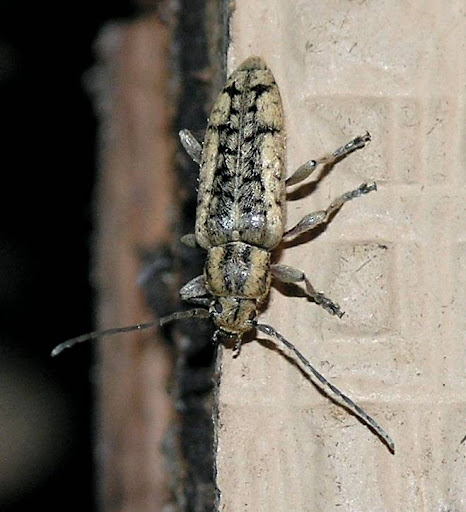
Small Cedar-bark Borer Beetle - Atimia confusa


Small Cedar-bark Borer Beetle - Atimia confusa
(Photo:  Marvin Smith on 3/9/09)


I found limited information about this relatively small (6-9 mm) Longhorned Beetle. According to BugGuide, Atimia confusa is widespread throughout the central and eastern U. S., is active in the spring and fall and is attracted to lights. (I photographed this specimen under our porch light.) Larval host plants are cedars and junipers.

.
Share/Bookmark

Monday, November 23, 2009

Flea Beetle - Kuschelina gibbitarsa


Flea Beetle - Kuschelina gibbitarsa
(Photo:  Marvin Smith on 11/14/09)


Flea Beetle General Description: Leaf-feeding beetles with a segment (femora) of the hind legs enlarged for jumping, which they will readily do when disturbed. Adult beetles chew small round or irregularly-shaped holes in plant leaves. Larvae typically feed on plant roots though some also feed on foliage. Many are serious agricultural pests, causing damage directly by plant feeding or indirectly by transmitting viruses. (Note: I suppose the flea beetle pictured here would actually be considered beneficial since it feeds on plants normally considered weeds.)

Species Identification: Typically four black spots on pronotum (short body segment between head and thorax) ... two spots toward the outer edges and two that blend together in the center ... iridescent green elytra (wing covers) ... approximately 5mm (1/4") long.

U. S. Range: Most of the eastern and central United States.

Host plants: Members of the mint family (Lamiaceae). Here in the Ozarks, I've found large populations of K. gibbitarsa on American Germander (Teucrium canadense).


Kuschelina gibbitarsa larvae on
American Germander leaf.

(Photo:  Marvin Smith on 6/25/08)

Comments: The beetle in the top photos was actually found while weeding a strawberry bed. Unfortunately, this bed was invaded by American Germander which we've been fighting for a couple of years. Like most members of the mint family, it is difficult to get rid of once established. K. gibbitarsa overwinter as adults. I'm sure this beetle was attempting to overwinter when we disturbed it with our weeding.


American Germander - Teucrium canadense
(Photo:  Marvin Smith on 6/24/08)


Share/Bookmark

Thursday, October 01, 2009

Sticky Lip and Friends


An oak tree along our road out is oozing a watery sap. From bubbles and smell of the sap, I'd say the oak has a hollow inside where the sap is fermenting. The tree splits into two trucks about three feet off the ground. I'd speculate it was damaged in last winter's ice storm. Regardless, a wide variety of insects from butterflies to beetles are feasting on the sap. Below are a few of the sap-feeders I've been able to at least partially identify.


Four-spotted Sap Beetle (Glischrochilus quadrisignatus): According to BugGuide the scientific name for this genus of beetle is formed from the Greek glischro, meaning sticky, plus chilus, meaning lip. Sticky Lip seems and appropriately descriptive name for a sap-feeding beetle.

Picnic Beetles is the common name for these beetles because they are often attracted to sodas and, especially, beer consumed outdoors.


Longhorned Beetle (Neoclytus sp.) Probably an Ash Bore, but I'm not certain.


Scarab Beetle: Fruit and Flower Chafer (Euphoria sp.) According to BugGuide, "Adults visit flowers for pollen and/or nectar. Also take rotting fruit." Obviously, adults also like fermented sap.


A faded and torn Hackberry Emperor Butterfly (Asterocampa celtis). Often feed on sap as well as fluids from dung and carrion.


Creative Commons License

.
Share/Bookmark

Tuesday, July 14, 2009

Long-horned Beetle (Elytrimitatrix undata)

What little information I could find on this beetle seems to indicate its larvae are found in dead wood, especially roots.

(Formerly Distenia undata)

.
Share/Bookmark

Monday, June 15, 2009

Banded Longhorn Flower Beetle (Typocerus velutinus)


Banded Longhorn Flower Beetle
(Typocerus velutinus)

Identification: Pattern usually distinctive: broad yellow bands on a chestnut background. Sometimes bands are weak. Tends to be larger than several of the other common Flower Longhorns. Yellow markings do not continue across the two elytra as a continuous band; instead, there is a break along the suture.

Range: Eastern North America

Life Cycle: Larvae feed on decaying hardwoods such as oak, hickory. Adults usually found in daytime, but do come to lights, so probably somewhat nocturnal.

Comments: Photo taken with Banded Longhorn Flower Beetle feeding on Queen Anne's Lace growing along our road out. They will feed on a variety of flowers, but seem to have a preference for Queen Anne's Lace.


Sources and additional images/information:

BugGuide Species Page
Cirrus Images
Stephen Cresswell Photography

.
Share/Bookmark

Thursday, June 11, 2009

Emerald Flower Scarab (Trichiotinus lunulatus)

(Photo: 6/09/09 by Marvin)

Emerald Flower Scarab (Trichiotinus lunulatus) Feeding on Ox-eye Daisy


Identification: Usually green, but sometimes has a coppery tinge. Legs usually green or dark, not brown. Cretaceous (chalky) spots on pygidium not usually concealed by hairs.

Range: Southeastern United States: Virginia to Texas.

Habitat: Meadows, fields, etc. with flowers, near woodlands.

Food: Pollen and/or nectar from a variety of flowers.

(Source: BugGuide)


.
Share/Bookmark

Tuesday, March 24, 2009

Checkered Beetle (Enoclerus ichneumoneus)

(Photo taken on 03/23/09 by Marvin)

Checkered Beetle (Enoclerus ichneumoneus)

Like many insects, Checkered Beetles do not have a significant economic impact upon human agricultural endeavors and, therefore, haven't been studies a great deal. About all I could find out about them is that both larvae and adults are predators. Some adults feed on pollen, some species are attracted to carrion and stored animal products. Their typical habitat is wooded areas where they can be found under bark, in galls and around woody plants. I have seen a checkered beetle eating squash bug eggs.

.
Share/Bookmark

Saturday, November 01, 2008

Soldier (Leatherwing) Beetles

Like almost all insects (except flies), beetles have four wings. However, in beetles the forewings are hardened into wing covers (elytra) that meet in a straight line down the back of the abdomen when closed. The elytra on soldier beetles (and their close relatives lightning bugs) are more hardened than other insect wings, but not as hard as those on most other beetles. These insects are often called leatherwings.

There are approximately 16 genera and 455 species of soldier beetles in North America. Most adults eat nectar and pollen, although a few are reported to eat other insects like aphids. Larval soldier beetles are generally carnivorous and feed on small soft-bodied insects.

Two of the more common soldier beetles are:


Margined Leatherwing
(Chauliognathus marginatus)

The identifying characteristic of the Margined Leatherwing Beetle is the wide black line running from front to rear down the middle of its pronotum (the short body segment between head and abdomen. The Margined Leatherwing is also most likely to be seen in the spring and early summer. (Photo from 5/17/06)


Goldenrod Soldier Beetle
(Chauliognathus pensylvanicus)
The Goldenrod Soldier Beetle has an irregularly shaped dot in the middle of its pronotum. The dot does not run all the way to the front or rear. This beetle is also most likely to be seen in the late summer and fall. (Photo from 9/6/08)
(The amount of black on the elytra of both species varies among individuals and is not significant for making an ID.)


Sources and additional information:
BugGuide: Goldenrod Soldier Beetle
BugGuide: Margined Leatherwing Beetle
University of Kentucky: Soldier Beetles
Chicago Wilderness Magazine: Margined Soldier Beetle

.
Share/Bookmark

Saturday, October 25, 2008

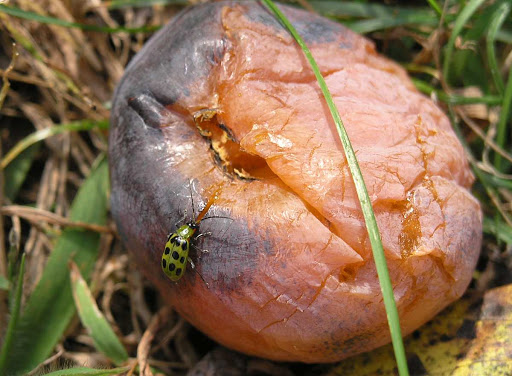
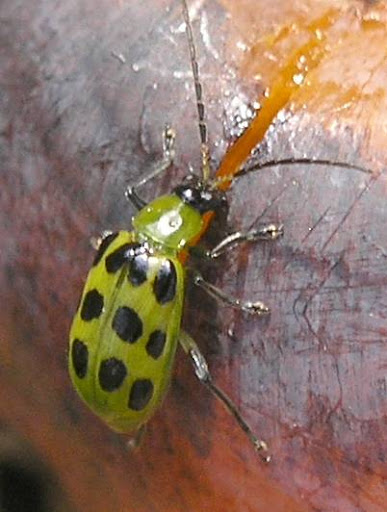
Spotted Cucumber Beetle (Diabrotica undecimpunctata)


Spotted Cucumber Beetle (Diabrotica undecimpunctata)

From a human perspective, this brightly colored, spotted little critter is a PEST.  The larvae (often called a Southern Corn Rootworm) feed on the roots of a large range of plants, including many field crops.  Adults will eat almost anything from cucumbers to roses.  Adults also transmit bacterial wilt and other diseases.

As with many other pest species, our experience with this beetle in our garden is that there is almost always a few around during the growing season, but they've never been a problem.  Their population has always remained at a background level.


This particular cucumber beetle is feasting on a fallen and partially fermented persimmon.  These persimmons are attracting many insects, mostly bees and wasps.  I've read about wild mammals becoming intoxicated after eating large amounts of fermented fruit.  I wonder if the same thing can happen with insects?  One the one hand, the alcohol content of the persimmons is low and the insects eat tiny amounts.  On the other hand, the body weight of  insects is minuscule.  It wouldn't take much alcohol to produce inebriation.  I mean, how can one tell if a beetle or wasp is flying under the influence of alcohol?

Source:  BugGuide
Share/Bookmark