Saturday, March 13, 2010

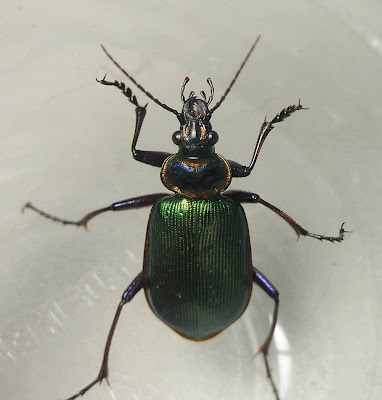
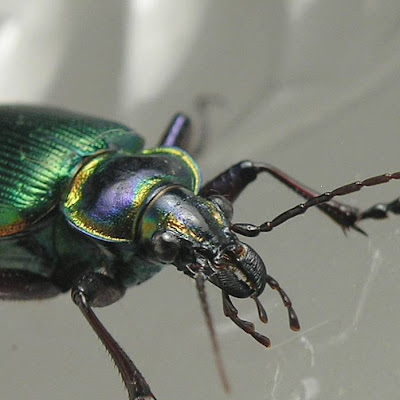
Fiery Searcher (Calosoma scrutator)

Photo taken 7/7/08
.
.
Fiery Searcher (Calosoma scrutator)
.
This brilliant, metallic green beetle is sometimes found in large numbers during the Arkansas spring, being attracted to lights at night. It may cause alarm because of its large size (it reaches 1 - 1½" in length) and the odor it emits to ward off predators and intruding humans. The wing covers have many fine longitudinal furrows that are beset with tiny punctures, and each cover has a reddish-copper border. The head, pronotum, and legs are deep metallic blue or purple, and the pronotum has a gold margin. Imprudent handlers could receive an unwelcome nip from the hefty mandibles. However, Calosoma scrutator is a highly beneficial species that climbs trees in search of caterpillar prey. Although the beetles are active from May to November, they seem to be especially numerous in May after trees are fully leaved out and while the spring flush of caterpillars is ravaging the foliage. Adults winter over, and they live up to 3 years. Eggs are placed one at a time in soil. Larvae also hunt caterpillars and climb trees and shrubs in search of prey. They pupate in earthen cells.
 
.

(Originally posted on 9/5/08)


.

Share/Bookmark

Saturday, March 06, 2010

Arkansas Moth: Rosy Maple (Dryocampa rubicunda)

Rosy Maple Moth (Dryocampa rubicunda)
(Photo:  Marvin Smith on 5/30/09)


Rosy Maple Moth
(Dryocampa rubicunda)

Were there a prize given for the most widespread, numerous and eye-catching moth, the Rosy Maple would probably win. Bob Patterson on MPG says this species has been the number one generator of ID requests, from southeastern Canada to Florida.

Hodges Number: 7715

Other common names: Green-striped Mapleworm (caterpillar)

Range: Eastern North America, including most of Florida.

Habitat: Deciduous forests.

Season: May-August in north (one brood), April-September in south (2-3 broods).

Food: Adults do not feed. Hostplants for larvae are maples, Acer, or oaks, Quercus.

Life cycle: Eggs are laid in clusters of 10-30 on foliage. Early instars are gregarious. Overwinters as pupa, below ground. Adults come to lights readily.

Caterpillars: Occasionally, D. rubicunda larvae can become serious defoliators. The caterpillar is usually most important as a pest on shade and ornamental landscape maples. Damage from loss of foliage is largely aesthetic; trees usually survive and recover, but some loss in growth and dieback in the crown may occur. (Please see Auburn University site for more information and photos.)

Species information from BugGuide.

Other links:
Moths of North America
MIACY


Please visit Xenogere for the latest edition of The Moth and Me Blog Carnival, and check out Jason's fantastic images of a wingless female moth.


.
Share/Bookmark

Thursday, March 04, 2010

Arkansas Moth: Angle-lined Prominent (Clostera inclusa)

Angle-lined Prominent Moth (Clostera inclusa)
(Photo:  Marvin Smith on 3/30/09)


Angle-lined Prominent Moth 
(Clostera inclusa)


Other common name: Many-lined Angle, Poplar Tentmaker

Hodges: #7896

Range: Throughout eastern North America.

Season: March-September.

Food: Larvae feed on aspen, willows, poplars.


Species information from BugGuide.

Other information and photos:

MIACY
MPG


.
Share/Bookmark
