Showing posts with label Spring 2009. Show all posts

Friday, May 29, 2009

Blue-eyed Grass (Sisyrinchium angustifolium)


Blue-eyed Grass (Sisyrinchium angustifolium)
.
Sisyrinchium angustifolium, commonly known as Stout blue-eyed grass or simply blue-eyed grass, is the most common blue-eyed grass of the eastern United States. It is a perennial plant growing in fields, meadows, and other grassy places. (Wikipedia)

Though their foliage is grass-like, the blue-eyed grasses belong to the iris family not the grass family. Sisyrinchium angustifolium is noted for its violet-blue flowers and branched flowering stems.

Best grown in medium moisture, well-drained soil in full sun. Tolerates light shade. Prefers consistently moist soils that do not dry out, but drainage must be good. Will freely self-seed in optimum growing conditions. (Kemper Center for Home Gardening --Missouri Botanical Garden)

The flowers are about three-quarters of an inch (1.9 cm) across, and stand erect above the leaves on slender grasslike flattened stalks. Individually, they are short lived, but the succession of flowers can last several weeks in spring and early summer.

Recent authorities have combined several previously recognized species (Sisyrinchium angustifolia, S. graminoides, S. atlanticum, and S. miamiense) into a single wide ranging species that occurs from Newfoundland and Quebec to southern Florida and west to eastern Texas. Its native habitat is open woods, moist pinelands, fields, meadows, marshes, the edges of swamps and grassy roadsides.  (Floridata)

Growing Conditions:

Water Use: Medium
Light Requirement: Sun , Part Shade
Soil Moisture: Wet , Moist
Soil Description: Moist, poor to average soils
Conditions Comments: This short-lived perennial will decline if allowed to dry out. Heavy mulch causes crown rot and rich, organic soils encourage rank, vegetative growth. Plants need to be divided at least every other year.

Propagation:

Propagation Material: Seeds
Description: Propagate by seed or division. Several dozen divisions can be expected from a mature, healthy specimen.
Seed Collection: Collect seed capsule when they have darkened to brown and become wrinkled.  (Lady Bird Johnson Wildflower Center)

The taxonomy of this genus is rather perplexing and confusing, as several of these species, such as Sisyrinchium angustifolium, form complexes with many variants named as species. More genetic research and cladistic analysis need to be performed to sort out the relationships between the species.  (Wikipedia)

Sisyrinchium: Greek sys for pig; rynchos for snout; referring to a pig grubbing the roots for food.

angustifolium: Latin for "narrow leaf"  (Robert W. Freckmann Herbarium -- University of Wisconsin)

Also: USDA Plant Profile and Distribution Map

.
Share/Bookmark

Sunday, April 19, 2009

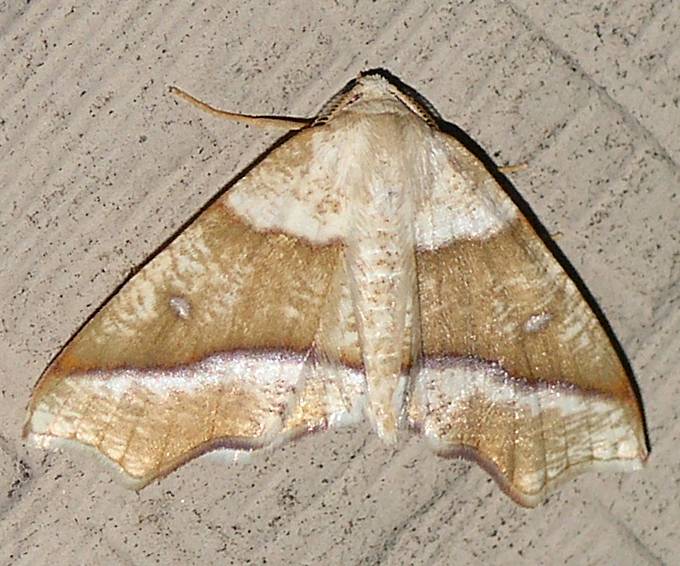
Hollow-spotted Plagodis Moth (Plagodis alcoolaria)

                                                                                                       (Photo taken on 4/18/09 by Marvin)


Hollow-spotted Plagodis Moth (Plagodis alcoolaria)


BugGuide Species Page:
Range - Eastern and central North America
Life Cycle - Larvae feed on deciduous trees (basswood, beech, maples, oaks)

Moths of Maryland:
Excellent photos of variability in this species.

University of Alberta Entomology Collection:
Adults come to light, and may also be active during the day ... Pupae overwinter ... Larvae are twig mimics.

Moth Photographers Group

.
Share/Bookmark

Warm-chevroned Moth (Tortricidia testacea)


Warm-chevroned Moth - Hodges#4652 (Tortricidia testacea)


University of Alberta: The caterpillars are short-legged and slug-like, and give the family their name, the slug-caterpillar moths. They are solitary defoliators of deciduous trees.

BugGuide Species Page: Range: Nova Scotia west and south to Manitoba, Missouri, Mississippi. (Obviously, they can range as far south as northern Arkansas.)

Moth Photographers Group: Another common name: Early Button Slug Moth.

Moths of Maryland: Larva feed on beeches, birches, black cherry, chestnut, oaks, and witch hazel.

.
Share/Bookmark

Thursday, April 16, 2009

Bi-Color Bird's Foot Violet (Viola pedata)

(Photo: 3/27/09 by Marvin)

Bird's Foot Violet (Viola pedata)

Bird's Foot Violet is a very common wildflower in the Ozark Mountains. It's preference for rocky and dry woodlands means it finds much of the Ozarks ideal habitat. Bi-color bird's foot violets are less common than solid colored, but one still sees many of them. The cluster pictured above was growing at the top of the first hill along our road out -- about the same place where the census taker abandoned her car and decided to walk the rest of the way down to our place -- definitely rocky.

According to Wildflowers of Missouri:


Flowering - April - June and sometimes again in late fall.
Habitat - Rocky or dry open woods, slopes, ridges, prairies, glades, roadsides.
Origin - Native to U.S.
Other info. - This is a striking and easily identifiable species. The flowers are very large and the leaves are finely divided and are similar to a birds foot. The common name for the plant is "Bird's Foot Violet".


Other Sources and Information:
Discover Life
Missouri Botanical Gardens

.
Share/Bookmark

Sunday, April 05, 2009

Painted Lady Butterfly (Vanessa cardui)

                                                                                                          (Photo taken on 04/04/09 by Jo)

Painted Lady (Vanessa cardui) on Eastern Redbud (Cercis canadensis)

.
Share/Bookmark

Monday, March 23, 2009

Today's Flowers: Bloodroot

                                                                                                                                      (Photo taken on 03/22/09 by Jo)

Bloodroot (Sanguinaria canadensis)

Bloodroot is a member of the Poppy family. Its name is derived from the red juice that can be extracted from it's red-orange roots (actually rhizomes). Various medicinal and mystical properties have been associated with this juice in the past. However, since the juice is escharotic (a substance that causes tissue to die and slough off) and an incorrect internal dosage is toxic, the FDA recommends that bloodroot not be used by herbal healers.


Related Posts:


To participate in Today's Flowers please click on the logo above.

.
Share/Bookmark

Saturday, March 21, 2009

Wild Plum Blossoms

                                                                                                       (Photo taken on 03/18/09 by Marvin)

Wild Plum Blossoms

According to the field guilds, we could have several different varieties of wild plums and they hybridize easily in the wild. I'm not even going to attempt a species ID.

.
Share/Bookmark

Thursday, March 19, 2009

Peach Blossom Time in the Ozarks


                                                                                                                                  (Photo taken on 03/18/09 by Marvin)


Peach Blossoms


Growing peaches in the Ozarks is an excellent hobby for anyone who thrives on dashed hopes and expectations.  Here in northern Arkansas we are far enough south that longer days and warmer temperatures coax our peaches into bloom about this time -- or a little earlier -- every year, but we are far enough north that we will get at least one more hard freeze -- hard enough to destroy blooms or recently set fruit -- four years out of five.


.
Share/Bookmark

Tuesday, March 17, 2009

Our 2009 Gardening Season Begins


Jo is weeding the bed where our red potatoes will soon be planted.


The veggie gardening season of 2009 has officially begun. On the one hand, it's terrific that we can finally get outside and get to gardening. On the other hand, ahead lies about six months of almost daily work out in the garden.


.
Share/Bookmark

Friday, March 06, 2009

Daffodil


One of our first daffodil blooms of Spring, 2009.  The first blooms actually opened yesterday, but it was much too windy to get a decent photo.  Today was still windy, but not quite so bad.

These earliest blooming daffodils are part of a group growing randomly at the edge of the woods, a group transplanted by dragline and bulldozer when our water line was installed a couple of years ago.  Tenacious!


.
Share/Bookmark