Showing posts with label bloodroot. Show all posts

Sunday, April 10, 2011

Bloodroot (Sanguinaria canadensis)


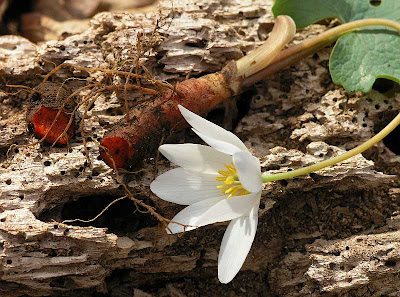
My blogging is starting to lag way behind both our photography and the season. Bloodroot is one of our earliest woodland wildflowers. Jo took this photo in mid-March.

Bloodroot is a member of the Poppy family. Its name is derived from the red juice that can be extracted from it's red-orange roots (actually rhizomes). Various medicinal and mystical properties have been associated with this juice in the past. However, since the juice is escharotic (a substance that causes tissue to die and slough off) and an incorrect internal dosage is toxic, the FDA recommends that bloodroot not be used by herbal healers.

.
Share/Bookmark

Sunday, March 13, 2011

Cutleaf Toothwort (Cardamine concatenata)


Cutleaf Toothwort


Other Common Names: Pepper Root
My best guess at an ID: Cardamine concatenata
Plant family: Brassicaceae (Mustard)
Habitat: Woodlands
Range: Throughout eastern and central North America
Plant Type: Native perennial
Lore: The roots (rhizomes) are said to have a peppery taste and can be eaten pickled, fermented (to make them sweet), boiled and eaten raw with salt. I haven't done a taste test.


This plant is the most prolific early-blooming wildflower in our woods. It doesn't have the most showy bloom, but is appreciated for it's abundance when little else is blooming. Cutleaf Toothwort is just starting to bloom in our woods.


Bloodroot will be the next early spring wildflower to bloom in our woods.

.

Share/Bookmark

Monday, March 23, 2009

Today's Flowers: Bloodroot

                                                                                                                                      (Photo taken on 03/22/09 by Jo)

Bloodroot (Sanguinaria canadensis)

Bloodroot is a member of the Poppy family. Its name is derived from the red juice that can be extracted from it's red-orange roots (actually rhizomes). Various medicinal and mystical properties have been associated with this juice in the past. However, since the juice is escharotic (a substance that causes tissue to die and slough off) and an incorrect internal dosage is toxic, the FDA recommends that bloodroot not be used by herbal healers.


Related Posts:


To participate in Today's Flowers please click on the logo above.

.
Share/Bookmark

Saturday, March 22, 2008

Bloodroot


Bloodroot (Sanguinaria canadensis)

The loop that Jo and I (and the dogs) usually walk every afternoon is only a couple of miles long, but contains a variety of habitats. There are hard-scrabble hillsides, pastures and one small area that I'd call a "rich woodland". On Friday, our treat for the day was finding bloodroot in bloom in this rich woodland area. I took numerous photos. These are not those photos. Jo's shots were much better than mine so I appropriated hers.

(Mon@rch has an excellent series of bloodroot photos showing the entire plant in various stages of bloom. Be sure to have a look at those.)


Bloodroot is a member of the Poppy family. Its name is derived from the red juice that can be extracted from it's red-orange roots (actually rhizomes). Various medicinal and mystical properties have been associated with this juice in the past. However, since the juice is escharotic (a substance that causes tissue to die and slough off) and an incorrect internal dosage is toxic, the FDA recommends that bloodroot not be used by herbal healers.

Share/Bookmark

Sunday, March 18, 2007

Bloodroot

From March, 2007


A look inside the root shows how bloodroot got its name. The root contains a red pigment that was once used as a dye.
Share/Bookmark

Tuesday, March 13, 2007

Wildflower Blooms Begin


We found the first bloodroot bloom of the season along our afternoon walking trail on Sunday.

The little purple violets growing out of a crack in a large rock are doing well, too.


From March, 2007

Share/Bookmark